


The shopper may need to understand a new mechanism, several components working together, an unfamiliar material or source story, a compatibility requirement, or why recurring use makes sense.
In those situations, the problem is often not a lack of information.
It is deciding what the customer needs to understand first, what should come later and what evidence belongs beside each decision.
OSMOS: giving an unfamiliar product system an order
Osmos
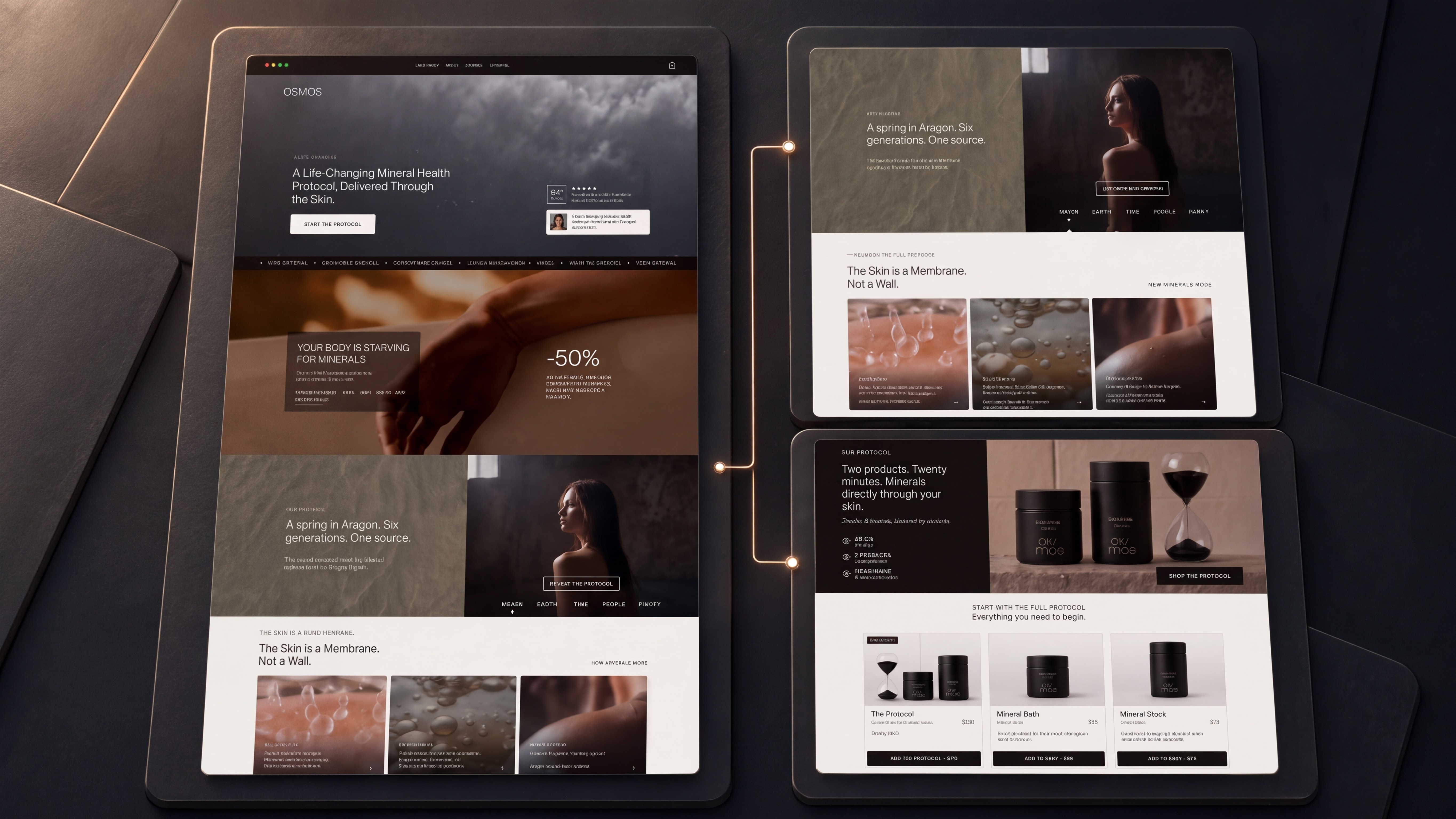
OSMOS is a useful example because the product could not rely on immediate category recognition.
The Osmos Reset combines a Peloid Mask, Mineral Soak and twenty-minute timer as one connected Protocol. A first-time shopper needs to understand what the system is, how the components relate and how the ritual works before the purchase options make sense.
It was to give the depth an order.
The homepage introduces the Protocol before moving into deeper source and mineral education. The product page becomes more specific about what is included, how the components work together and how the purchase is configured.
One-time and recurring options then become part of a decision the shopper already understands.
The mechanism may appear before the customer understands the basic value. Research may sit beside a claim without making clear what it supports. Compatibility information can arrive too late. A subscription option may ask for recurring commitment before the reason for recurring use is clear.
UXphoria looks at how those questions develop across the buying journey

The aim is to make the product understandable enough to evaluate, then introduce deeper evidence as the customer's questions become more specific.

1
1. Outcome
Can a first-time shopper understand what the product is for and why it may matter to them? The customer should not need to decode the mechanism before recognizing the value.
2
2. Mechanism
Once the outcome is clear, does the product explain how it works at the right level of depth? Some customers need a short explanation. Others will want to investigate further. The hierarchy should support both without turning the page into documentation.
3
3. Matched evidence
Does the proof actually answer the claim beside it? Reviews, studies, materials, sourcing, expert context and product demonstrations do different jobs. They become more useful when they resolve a specific uncertainty rather than acting as a general credibility layer.
4
4. Compatibility
Can shoppers understand whether the product, version, configuration or system fits their situation? Compatibility may involve dimensions, routines, product goals, existing equipment, usage conditions or several products designed to work together.
5
5. Commitment
Are higher-consideration choices understandable before the customer is asked to commit? That may include bundles, quantities, subscriptions, recurring delivery or a multi-component product system.
6
6. Cart confirmation
Once the decision has been made, does the cart clearly confirm what was selected, what it includes and what happens next? The diagnostic is not a template every store has to follow literally. Its job is to locate where understanding stops supporting the purchase.

A rigorous experience does not have to feel clinical.

Customers understand the product, but the PDP still creates uncertainty around value, evidence, variants, compatibility, price or add-to-cart action.
That is a more specific problem.
Our Shopify product page optimization work goes deeper into PDP decision architecture, trust timing, media hierarchy and the moments directly surrounding product selection.

Here, the focus stays broader: how evidence and understanding develop across the journey.

The expectation may already be wrong before the shopper arrives. Product education may begin too late. A recurring option may look confusing because the reason for recurring use was never established. Mobile may expose an information hierarchy that was already weak.
When several explanations remain plausible, a conversion audit is the better starting point.
The purpose is to identify where the buying decision is actually losing clarity before deciding what deserves redesign.


Some products genuinely need more explanation.
The CRO opportunity is not to strip that explanation away. It is to give customers the right understanding, evidence and reassurance as the purchase becomes more concrete.
UXphoria helps DTC teams structure that journey while protecting the product depth and brand value that made the proposition distinctive in the first place.

